

This workshop proudly hosted in collaborative partnership with the IEEE Society on Social Implications of Technology (SSIT) and the International Society for Artificial Life (ISAL).
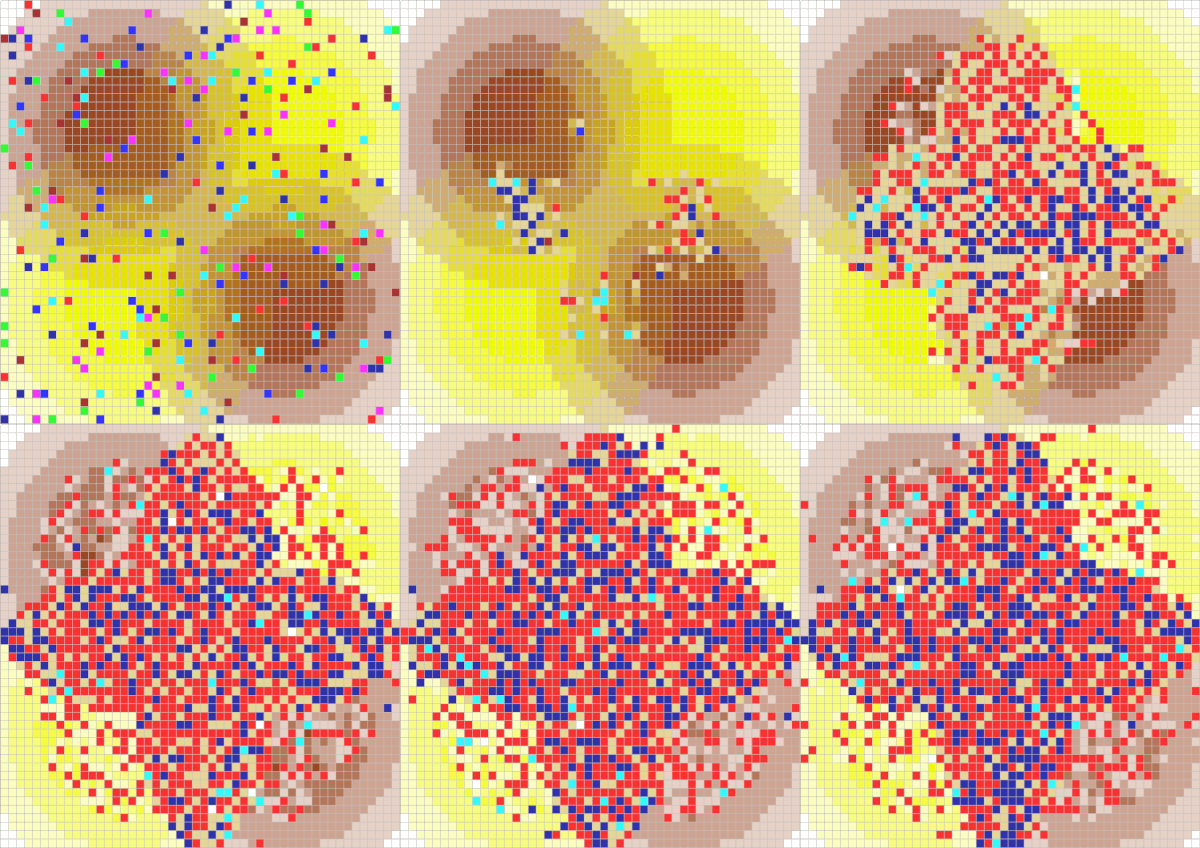
Sugarscape is a robust agent-based model first introduced in 1996 for simulating complex emergent social behaviors. Thirty years later, it still remains a useful platform to investigate societal-scale issues. Recent topics of investigation include universal basic income, ethical behavior modeling, and societal effects of depression, greed, and tax structures. Unlike many agent-based models, Sugarscape is less about the agents themselves and more about the interactions between agents which coalesce into a society. One of the more appealing aspects of Sugarscape is how social relationships and structures emerge organically among autonomous agents in response to the environment. This reinforces the observation that a reductionist philosophy towards simulation cannot capture the underlying causes that inform agent behavior.
In this workshop, we provide a rich survey of Sugarscape through its decades of use. This includes the context in which Sugarscape was first devised, its evolution over time, and future directions. We demonstrate how Sugarscape can serve as a central hub for cross-disciplinary collaboration to address these open questions. We seek to create a research community that leverages Sugarscape to grapple with especially compelling open problems for early and mid-career researchers.
The format of the workshop will be a mix of presentation and collaborative, birds-of-a-feather discussion. We invite participants to suggest new problems and forge research partnerships that persist beyond ALife 2026. Although this is not a tutorial, we will provide a brief overview of our implementation of the Sugarscape model which is a free and open source project available for download.
Ankur Gupta (Butler University)
Nate Kremer-Herman (Seattle University) - Digital Terraria Lab
Joshua M. Epstein (New York University)
Heather Love (University of Waterloo) - IEEE SSIT